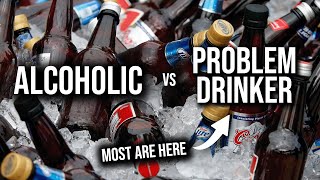
Not ready to quit entirely? Harm reduction and moderation offer a middle path for people who want to drink less, not stop completely.
If you drink heavily, are you by definition an “alcoholic”? Not according to the CDC — and not according to fifty years of clinical science. The truth is that alcohol problems exist on a spectrum, from mild to severe, and the majority of people who struggle with their drinking do not fit the traditional image of someone who has lost everything. Most are privately struggling — holding down careers, maintaining relationships, and quietly wondering whether their drinking has crossed a line.
If that describes you, harm reduction may offer exactly the kind of flexible, intelligent help you have been looking for.
What Is Harm Reduction?
Harm reduction is based on a simple premise: any steps taken to reduce or eliminate the harmful effects of heavy drinking are steps in the right direction. Unlike traditional approaches rooted in AA and the 12-step model, harm reduction does not adhere to the all-or-nothing view that abstinence is the one and only way to address a drinking problem.
Instead, harm reduction accepts each person’s right to choose their own behavior-change goals and supports any efforts they make to reduce or eliminate negative consequences. For many people, exploring alternatives to Alcoholics Anonymous opens the door to treatment they might otherwise avoid entirely. It is estimated that roughly half of all people with alcohol problems never seek help, and rigid abstinence-only requirements are a major reason why.
Potential Goals in Harm Reduction
Within a harm reduction framework, drinking goals might include:
- Safer, less risky drinking — avoiding dangerous situations like drinking and driving
- Reduced drinking — cutting back on frequency or quantity
- Truly moderate drinking — finding your “off switch” and maintaining consistent control
- No drinking at all — total abstinence, if that becomes the preferred or necessary goal
The flexibility of this approach makes it particularly appealing to high-functioning professionals and executives who may be reluctant to label themselves as “alcoholic” or commit to lifelong abstinence before exploring other options. One size does not fit all.
Gray Area Drinking: When Alcohol Becomes a Concern Without Being “Alcoholism”
One of the most important developments in understanding alcohol problems is the recognition of what I call gray area drinking — the space between casual social drinking and severe alcohol use disorder. If you find yourself questioning your relationship with alcohol but do not identify with the stereotypical picture of an “alcoholic,” you are likely in this gray area.
Gray area drinking often looks like this:
- Regularly drinking more than you intended
- Using alcohol to cope with stress or uncomfortable emotions
- Feeling unable to relax or enjoy social situations without a drink
- Experiencing mild hangovers or regret after drinking
- Worrying about your drinking but not experiencing major consequences
- Successfully managing work and relationships despite growing concerns
- Wondering whether your drinking is normal or becoming problematic
The traditional treatment world has long presented a binary choice: either you are an “alcoholic” who needs lifelong abstinence, or you do not have a problem at all. This false dichotomy leaves gray area drinkers feeling confused and unsure where to turn. Harm reduction approaches fill that gap by offering practical strategies for people who want to address their concerns before they escalate.
When Moderation May Be Possible
Harm reduction and moderate drinking strategies are supported by decades of scientific research, including the NIAAA’s Rethinking Drinking guide. Studies in the U.S. and abroad have shown that, with proper guidance and support, many people with less severe drinking problems can learn to moderate their alcohol consumption within safer limits.
Moderate drinking programs may be appropriate if you:
- Have never been physically dependent on alcohol — no severe withdrawal symptoms
- Have not had repeated failed moderation attempts with professional guidance
- Are experiencing mild to moderate alcohol-related problems rather than severe consequences
- Do not have medical conditions requiring complete abstinence
- Are willing to commit to monitoring and controlling your drinking consistently
- Have stable life circumstances and are not in the middle of a major crisis
When Abstinence May Be Necessary
Conversely, total abstinence may be the better choice if you:
- Have experienced severe physical dependence or withdrawal symptoms
- Have tried moderation multiple times without success, even with professional support
- Have medical conditions made worse by any alcohol consumption
- Are taking medications that interact dangerously with alcohol
- Have a history of severe consequences from drinking
- Prefer the simplicity and clarity of complete abstinence
The question is not “Are you an ‘alcoholic’?” but rather “What approach will work best for your specific situation?” Sometimes the answer requires some experimentation with professional guidance. Sobriety sampling — trying abstinence as an experiment — can provide valuable information about your relationship with alcohol and whether moderation is realistic for you. The SAMHSA National Helpline is also a confidential resource that can help you explore your options.
Finding a Self-Respecting Path Forward
If you are concerned about your drinking but unsure what to do about it, I would encourage you to start with an honest look at where your drinking falls on the spectrum. You do not need to call yourself an “alcoholic” to get help, and you do not need to commit to lifelong abstinence before you walk through the door. A confidential conversation with a professional who understands the full range of options can help you find the approach that makes sense for your life.