Not sure if you're an alcoholic? Alcohol Use Disorder exists on a spectrum from mild to severe. Find out where you fall and what treatment fits.
Can you be “a little bit alcoholic”? Well, yes — sort of. You can have a mild alcohol use disorder or a moderate one without ever developing a severe problem. And that distinction matters enormously, because it changes what kind of help makes sense for you.
The Spectrum Changes Everything
For decades, the thinking about alcohol problems was binary: either you were an “alcoholic” or you weren’t. You either needed to go to AA and never drink again, or you were fine. That all-or-nothing framework kept millions of people from getting help — people who knew their drinking wasn’t entirely fine, but who also knew they didn’t fit the stereotype of someone hitting “rock bottom.”
With the recognition that alcohol problems lie on a spectrum — from mild to moderate to severe — we can now ask a much better question: are there different treatments for people who have different levels of severity? And the answer is yes. It’s helped us get away from the all-or-nothing mentality that total abstinence is the one and only way to deal with the problem.
According to the National Institute on Alcohol Abuse and Alcoholism, alcohol use disorder is a medical condition characterized by an impaired ability to stop or control alcohol use despite adverse consequences. But the severity varies enormously from person to person, and so should the treatment.
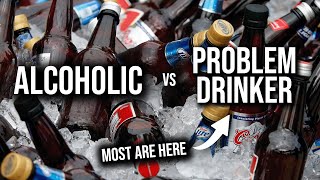
This is especially important for high-functioning individuals who may not fit the traditional stereotype. Many fall into what’s known as gray area drinking — drinking more than recommended guidelines but without severe dependence. The question “am I a problem drinker or an alcoholic?” is being replaced with a far more useful framework that recognizes the continuum.
The Diagnostic Criteria
The severity of alcohol use disorder is determined by how many diagnostic criteria you meet. These criteria fall into several categories.
Drinking Patterns and Control
- Do you frequently end up drinking more than you intended to?
- Do you have cravings, compulsions, or preoccupation with drinking?
- Do you spend a lot of time drinking or recovering from drinking?
Impact on Your Life
- Have you given up important activities — recreation, sports, time with family and friends — in favor of drinking?
- Do you find yourself acting in ways that alienate people or cause conflict in relationships?
- Is your drinking affecting your marriage, your relationship with your partner, or your connection to family and close friends?
Tolerance and Withdrawal
Two critical criteria relate to physical dependence. Are you drinking more than you have in the past to achieve the same effects — developing a tolerance? And do you experience any withdrawal when you stop drinking?
According to the Centers for Disease Control and Prevention, developing tolerance is a warning sign that your body is adapting to regular alcohol exposure, which can indicate progression along the spectrum.
The Severity Levels
- Mild AUD: 2-3 symptoms present
- Moderate AUD: 4-5 symptoms present
- Severe AUD: 6 or more symptoms present
The Physical Dependence Misconception
A lot of people make the mistake in thinking that if they don’t have the shakes and aren’t physically dependent on alcohol, then the problem must not be that bad. But physical dependence is simply one set of symptoms. If you’re physically dependent, chances are you’ll qualify in other respects as well — but the absence of physical dependence doesn’t mean there’s no problem.
Here’s something many people overlook, and it’s one of the most reliable hallmarks of physical dependence: feeling anxiety — sometimes panic-level anxiety — or significant agitation in the day or two after a drinking episode. Severe anxiety after drinking is a very reliable sign that you may have a physical component to your alcohol problem, even if you’ve never experienced tremors or the dramatic withdrawal symptoms people associate with severe dependence.
Why the Spectrum Matters for Treatment
This is where I get genuinely excited about how the field has evolved. Rather than a one-size-fits-all approach, we can now offer personalized treatment that matches the severity of the problem. For some people, a moderate drinking program is entirely appropriate. For others, abstinence is clearly the better path. And for many, attempting moderation serves as a stepping stone — they discover through their own experience what works and what doesn’t, and they arrive at abstinence through conviction rather than coercion.
The point is that treatment should be tailored to the person, not the other way around. Clinical science, not ideology, should guide the process.
Assess Your Drinking Patterns
Wondering where you fall on the spectrum? Take our free AUDIT Self-Assessment Quiz — 10 confidential, clinically validated questions developed by the World Health Organization. It’s a useful starting point, not a diagnosis, but it can give you a clearer picture of where things stand.
If you’re concerned about your drinking — even mildly concerned — that concern itself is worth paying attention to. A confidential consultation can help you understand your options and find an approach that fits your situation and your goals. No labels required.